
Water Treatment - Flow Forward Overhaul
Overview
Background
Flow Forward is the title for the game created under the funded project titled “Water Treatment” in collaboration with the City of Scottsdale and Arizona State University. The goal of the game was to create a family-friendly way to explain Arizona’s Advanced Water Purification system to people of all ages to promote the safety of Arizona's water quality. The game has 4 mini games, an introduction, and an outro establishing a short narrative. The story involves the player shrinking down to learn about Advanced Water Purification by going directly into the system with a robot friend and battling bacteria and contaminants in various stages of water purification to bring clean water back to Arizona scientists and policymakers.
Methodologies
-
User testing
-
Task analysis
Redesign Goal: Shorten the original experience to make it easier to present at events with limited playtime; make interactions more tactile.

Scope: 12 months, June 2025 - June 2026
Role: Project Lead, UX Developer, 3D Artist
Toolkit: Google Sheets, Blender, Unity
Previous State of the Project
Summer 2025
Upon leadership transition of the project from the previous lead to myself, a couple of issues were raised by the stakeholders that needed to be addressed about the core project.
-
The current game was far too long to present in classrooms, museums, and at conferences.
-
The UI felt incredibly flat and was causing disconnect between the VR users since interactions weren't obvious or intuitive.

Source: Flow Forward Unity (Feb. 2024)
User testing during demos at conferences displayed frequent issues where many people: felt as if they didn't have enough time to play through the whole game; they felt motion sick from sitting in the headsets for too long; or, the had a hard time pressing any of the buttons in VR using their hands since flat buttons are often times less responsive than 3D buttons in virtual reality.
Stakeholders wanted to get people through the game faster and make the interactions more clear by the Beta version of the released game.

Source: Flow Forward Build (March. 2024)
Multiple Versions
Long, short, and shorter!
To be able to accommodate the time of multiple audiences (at home, conferences, museums, schools, etc.), we decided to create multiple different versions of the experience deployable on the different platforms. Each platform would have a standard "long" version that included a unique second scene with water beaker interactions and additional button interactions that led to learning more detailed information about the water purification process. A short version would have an abbreviated version of this scene that would move the player faster through the narrative. Finally, a mini version of the experience was created that excluded all the narrative portions of the game, cutting out about 8 minutes of experience in favor of providing just the mini games to fast demonstrations such as school showcases across the valley and installations at local museums.
Skip and reset
To help the audience in another capacity, we noticed during demos that some people needed to get through the experience faster. Additionally, we as a development team found it tiring to constantly play the entire experience every time we needed to rest just a single game in its built state. Originally, the stakeholders wanted to add secret gestures that would allow users to skip scenes in the experience. However, these gestures just needed extra explanation and were unreliable (either triggering by accident or not at all). Therefore, we decided to add some physical buttons in the scene that could act as skips and emergency resets for the games. There was concern that users would begin to spam skip the games to say they "beat" the game, though we have found so far that people rarely find the need to use them at events and showcases.

Adding the skip/reset also let people take their time or speed through the game at whatever pace they would like from home. This way, they had no pressure to experience the whole game within a limited amount of time, or they could choose to experience only certain portions.
Redesigning the Games
Replacing the Dashboard


The original dashboard was designed using UI that had only desktop controls in mind. The game was always intended to be played in virtual reality, yet the UI felt too flat for this purpose. There were instances where users were experiencing unresponsive feedback from the buttons, confusion as to what was and was not a button, and frustration from inaccurate interactions.
To address this issue, we chose to replace the initial dashboard with a new one. We kept many of the UI bars the same as they were not interactable and were originally intended to just provide information. However, we changed all the flat buttons to 3D buttons such as the net launcher, the boost button, and the test water buttons. Additionally, we changed the controls for our Reverse Osmosis game. Originally, it required users to hold down certain arrows to move in a direction. Though, now, we changed it so that the dashboard animates and pops up into a go-kart controller that lets the users more intuitively drive the submarine they are in like a car.
Cutting Content
Boss be gone
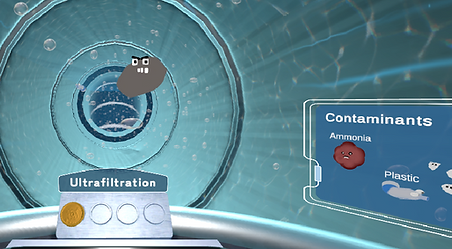
Originally, the Ultrafiltration game had a big boss bacteria that the players had to shoot multiple nets at in order to capture. However, users at events were complaining that it felt too repetitive and unnecessary since the rest of the game was similar. Since we needed to shorten the game anyway, we cut the boss and the number of contaminants needed to be captured from 14 to 7.
Feedback: Users welcomed this version more, saying that it felt quicker, to the point, and still conveyed the original message that taught them what Ultrafiltration was.
Fewer contaminants
Mini games such as Ozone and Ultrafiltration also had their enemies (the bacteria and contaminants) reduced by more than half in order to speed up the playtime. Initial feedback found that the mini games, while fun, would get old rather quickly as they were meant to be a more interactive methods of conveying the information presented in the current stage of water purification than provide long term fun.
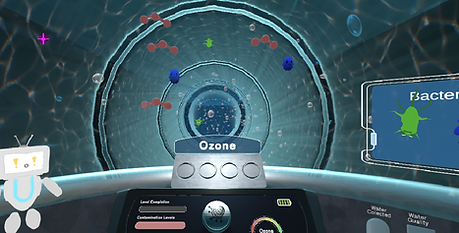
Feedback: Users playing the quicker versions of the mini games were overall providing better ratings during their feedback sessions than those that were playing the original long versions that had them defeating larger quantities of enemies.
Conclusion
Overall, we redesigned a game that was a longer, flat experience to be more to the point and called back more to call more on the users' muscle memory and reduce the cognitive load that indirect UI and long gameplay was causing. This gave us new insight into developing our educational experiences. While we traditional think that users may prefer long experience with cool pictures and visuals just due to the novelty of VR, we need to keep in mind realistically that many users cannot stand or have the time to sit in a virtual reality headset for long or have an interest in playing something educational for long periods of time. The goal of this educational experience was to communicate the content in an enjoyable and accessibly way. In this instance where the information needed to be communicated quickly and easily for events, the previous team had lost themselves in overdesigning the 2D graphics and creating long narratives with repetitive gameplay actions.
While the repetitive nature works well in reiterating and reinforcing the information that the stakeholders and subject matter experts wanted to teach, after some time, the game does become boring. Holding onto a user's attention requires fresh interactions more often, and cutting content and shortening the time of the gameplay resulted in much better feedback in the long run.

